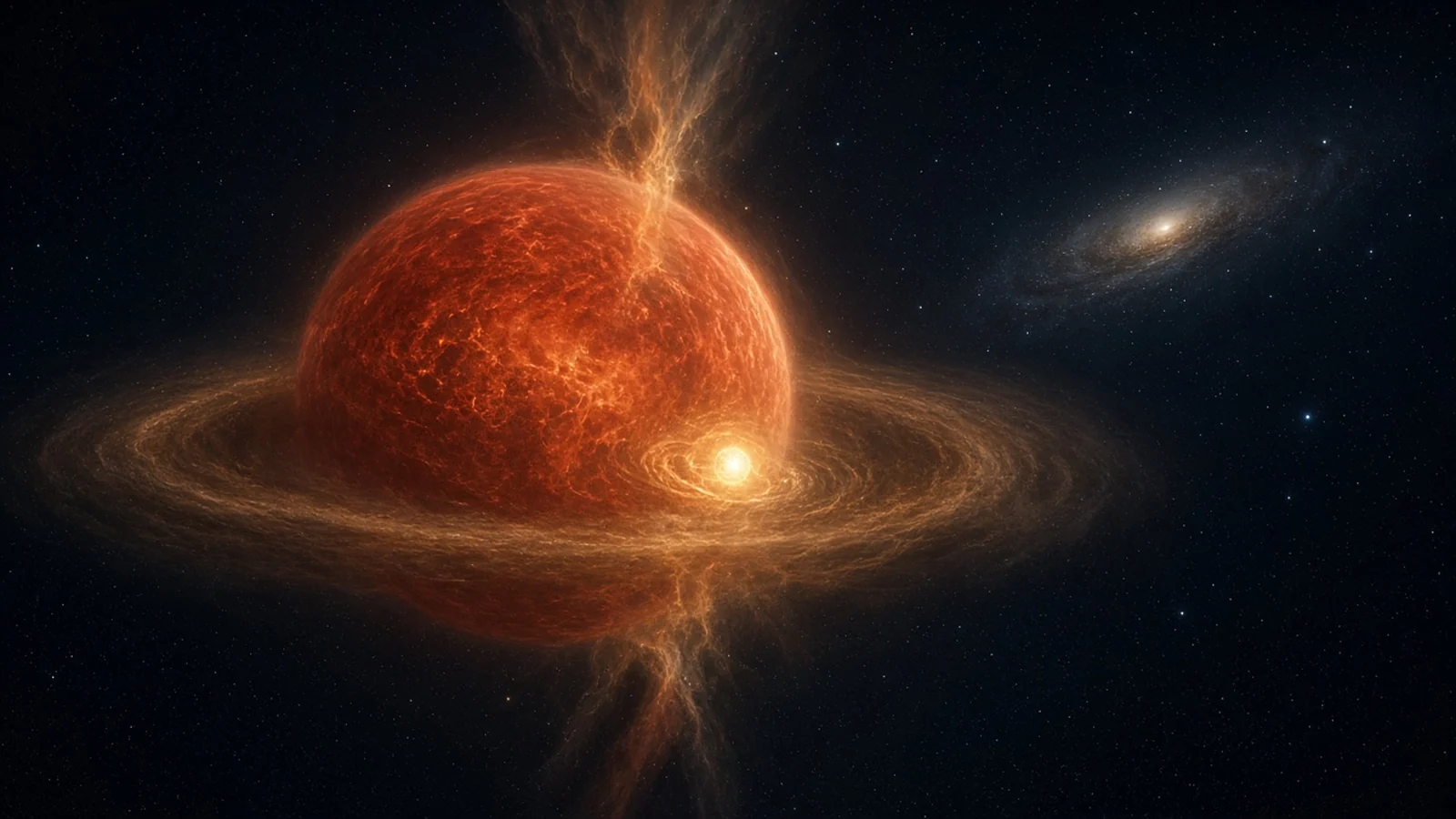
Common-envelope evolution is one of the most important poorly observed steps in the lives of close binary stars. In a paper published in Nature on November 18, 2026, Viraj Karambelkar of Columbia University, a NASA Hubble Fellow, and colleagues argue that they have now watched it happen. The event, officially named AT 2025abao and nicknamed Bao, was a transient eruption in the Andromeda galaxy. The team's analysis is that a companion of about 0.7 solar masses spiraled through the convective envelope of a roughly 7-solar-mass asymptotic-giant-branch (AGB) star, then merged with that star's core.
The paper is "An inspiral of a star inside a common envelope with its giant companion" (DOI 10.1038/s41586-026-11221-z), Nature volume 659, pages 628–633. The figures below come from the published paper and from the authors' matching preprint (arXiv:2611.23470). NASA's Webb mission team issued a companion release the same day. Claims that could not be checked against those sources are left out.
01The first direct view
Theories of compact-binary formation have long required a way for two stars to shrink their orbit quickly. The standard idea, common-envelope evolution, is that the stars end up orbiting inside a loosely bound, shared envelope of gas. Frictional drag then steals orbital energy and the companion spirals inward. "This inspiral in such a system has never been observed directly," the new paper states, before presenting AT 2025abao as that missing view.
The system is also unusual among known luminous red novae, the class of transients already linked to stellar mergers. Previously known progenitors, the authors say, were stars on the main sequence or in the Hertzsprung gap, whose tightly bound radiative envelopes are expected to drive a merger. AT 2025abao's primary is an evolved AGB star with an extended convective envelope — the kind of system assumed in the classical picture for compact-binary formation. "AT 2025abao provides the first view of a classical CEE progenitor system continuously monitored from its onset through its culmination."
The event sits in the Andromeda galaxy, about 2.5 million light-years away, according to NASA's November 18 release. Earlier internal names for the same source, used before the eruption, were WNTR23bzdiq and WTP19aalzlk.
02Years of quiet, then a slow rise
The quiescent progenitor, the paper reports, "shows no signs of variability between 1989 and the start of its brightening in 2018." Modeling of its spectral energy distribution, first presented in an April 2025 Astrophysical Journal paper by Karambelkar and colleagues, is consistent with a roughly 7-solar-mass star in its early-AGB phase: a temperature of about 3,650 kelvin, a radius of about 350 solar radii, and a luminosity of about 18,000 solar luminosities. A large infrared excess implied a wind of about 10−5 solar masses per year, higher than expected for an isolated early-AGB star.
From 2018 to early 2025 the star brightened gradually, in two episodes that raised the optical flux by a factor of two to three over about 1,000 to 1,500 days, at a nearly constant temperature of about 3,800 kelvin. It then faded by a factor of about two in optical light over roughly 300 days, even as its infrared emission continued to brighten by a factor of at least five and the photosphere cooled to about 3,500 kelvin.
In July 2025, NASA's SPHEREx mission observed the source by chance during that optical fade. The stellar radius and luminosity had grown to about 860 solar radii and about 100,000 solar luminosities, with a temperature of about 3,460 kelvin. The data also imply a substantial increase in circumstellar dust, corresponding to the ejection of about 0.1 solar masses of gas and a mass-loss rate of about 10−2 solar masses per year at that epoch. NASA and a Caltech/Zwicky Transient Facility release add that the unusual behavior first stood out in 2023, independently, in data from NASA's retired NEOWISE mission and Palomar's Wide-field Infrared Transient Explorer, after which Karambelkar and co-author Kishalay De joined forces.
03What a common envelope is
A common envelope is not a third star. It is the shared outer layer that forms when a companion begins to orbit inside a giant's bloated atmosphere. Drag then robs the companion of orbital energy, and the orbit shrinks. In some systems both stars survive, shedding mass and ending up in a tight pair that may later become white dwarfs, neutron stars or black holes, or sources of gravitational waves. In others the companion plunges all the way in.
The seven-year precursor, the authors argue, is that inspiral, not ordinary pre-merger outflows. Other luminous red novae often brighten over tens to hundreds of orbits, a signal attributed to outflows that can hide the inspiral itself. For AT 2025abao those outflows are energetically insufficient: the primary's low escape speed, about 85 kilometers per second, cannot power the observed precursor luminosity of about 1038 erg per second even if all of the outflow's kinetic energy were radiated away. The seven-year rise also spans fewer than ten orbits at the surface, "substantially shorter than the other LRNe."
A Bondi-Hoyle estimate of frictional drag on a 0.7-solar-mass companion near the photosphere yields about 3 × 1038 erg per second, consistent with the extra light, and an inspiral timescale of about 1,000 days, or a few orbits. During this slow phase, most of the dissipated orbital energy was radiated away, and the star's nearly constant temperature and steadily increasing radius point to a quasi-static expansion, likely helped by convection. The last 300 days, marked by a temperature drop, are interpreted as the start of a rapid plunge toward the core, lasting about ten dynamical timescales of the envelope.
04The October 2025 eruption
In October 2025, immediately after the rapid optical fade, the star erupted. It brightened by a factor of about 100 in the r band over 25 days, and its photospheric temperature jumped to about 8,000 kelvin. Over the next eighty days the luminosity plateaued while the temperature cooled to about 3,000 kelvin. The peak bolometric luminosity reached about 1.5 million solar luminosities, with a photospheric expansion speed of about 330 kilometers per second.
NASA and a Caltech/ZTF release both date the visible flash to October 17, 2025. The ZTF release says amateur astronomer Koichi Itagaki reported it that day, with later notices from the MASTER robotic-telescope network and a Kyoto University Astronomer's Telegram; the Nature paper cites that telegram (Taguchi and Maeda, ATel 17468) for early spectra. Palomar's ZTF and WINTER also captured the event, with follow-up from Gemini North, Palomar's Hale telescope, and NASA's Swift observatory and Infrared Telescope Facility.
Early spectra showed hydrogen emission about 900 kilometers per second wide. Over the next roughly 80 days that emission narrowed and strengthened, which the authors read as fast ejecta decelerating to about 150 kilometers per second as they ran into slower circumstellar gas. Late-time line profiles were asymmetric, a pattern the paper compares to disk-like material seen nearly equator-on. From the rise time, set by photon diffusion through the ejecta, the authors infer that the merger ejected about 0.1 to 0.2 solar masses. They argue that this material expanded freely at the poles but was blocked by circumbinary gas at the equator, and that the resulting shocks released enough energy to power the eruption's plateau.
05What Webb added
On December 24, 2025, 47 days after the g-band peak, the team obtained James Webb Space Telescope observations under a Director's Discretionary Time program, coinciding with a second SPHEREx visit. NASA calls that the earliest follow-up of an event of this kind. Modeling of the combined mid-infrared data found a warmer photosphere than during the precursor, surrounded by an optically thin dust shell at about 5 × 10⁴ solar radii. That shell, the authors conclude, lies beyond both the farthest the 2025 ejecta or the seven-year precursor outflow could have reached and the farthest radius at which the eruption could have sublimated dust. Webb was therefore looking at leftover dust from the progenitor's earlier mass loss, totaling about 6 × 10⁻⁵ solar masses around the quiet star about ten years before the eruption.
Those dust measurements also pin down the companion. Comparing the dust around the quiet system with models of unstable mass transfer constrains the mass ratio to about 0.1, so a companion of about 0.7 solar masses. A second estimate, from mass loss during the inspiral, gives a consistent ratio. NASA and Caltech both note that the primary outshone this companion by a factor of about 18,000, which is why it was never seen as a separate star.
Whether the companion survived is a central question, and the paper treats the merger as an inference. The observed kinetic energy of about 1048 erg requires the companion to have spiraled in to about 3 solar radii, coincident with the helium core of the primary. The total unbound mass from the precursor and the eruption, about 0.2 to 0.4 solar masses, is only about 10 percent of the envelope, which they read as evidence that most of the envelope is still intact, rather than fully ejected as expected for a surviving binary. The eruption also resembles other luminous red novae already identified as mergers. "We therefore suggest that AT 2025abao represents a CEE event that culminated in the merger of the binary components, which can be directly tested with future observations."
06What it means for the models
The same data give a rare empirical bound on the common-envelope efficiency parameter α, which is meant to describe what fraction of dissipated orbital energy goes into unbinding the envelope. For an inspiral of a low-mass companion (mass ratio about 0.1+0.10−0.05) down to the helium core of the 7-solar-mass primary, the paper estimates a released orbital energy of about 8 × 1047 erg and an envelope binding energy of about 1.6 × 1047 erg. A merger that fails to eject the envelope then implies α ≲ 0.2+0.2−0.1. The energy needed to unbind only the observed outer material, about 1046 erg, implies α ≳ 0.01. Together those bounds are written as 0.01 ≲ α ≲ 0.4, consistent with values of about 0.1 to 0.3 inferred from already-known post-common-envelope binaries.
The authors immediately qualify that result. The usual formalism assumes that transferred orbital energy is spent mainly on unbinding the envelope. In AT 2025abao, the dominant energy sink during the rapid plunge was instead the acceleration of a small fraction of the envelope to speeds far above the local escape speed — about ten times the primary's escape speed of roughly 85 kilometers per second. Almost all of the dissipated orbital energy, about 1048 erg, went into kinetic energy; only about 1 percent was radiated, and a similarly small amount went into unbinding the observed ejecta. That is the reverse of the slow inspiral, when most of the dissipated energy was radiated away. "The formalism thus provides a useful parametric prescription for predicting CEE outcomes, but fails to capture all the underlying physics."
The ejecta also appear bipolar: free to expand at the poles, confined at the equator. The paper says that geometry "confirms the long-standing hypothesis that bipolar planetary nebulae can be shaped by CEE in binary stars." The same process in giant stars is a key step in forming close white-dwarf binaries, including gravitational-wave sources that the future Laser Interferometer Space Antenna could detect.
07What is still open
The merger itself is a well-supported inference, not a photograph of two stars becoming one. It rests on the energy budget, the small unbound mass, and the resemblance to other luminous red novae. The authors say it can be tested with future observations; a Nature Portfolio note on the paper likewise said that future observations will be needed to confirm the merger conclusively. What the newly single star looks like as its structure settles, NASA notes, is still unknown.
Where press accounts differ from the paper, this article follows the paper. The measured rise is a factor of about 100 in the r band over 25 days. The precursor begins in 2018 in the paper, while a ZTF release describes archival Palomar plates as showing a rise around 2019.
The wider payoff is a method. Because the team had years of pre-eruption data, then caught the plunge, the eruption and the immediate aftermath, they could measure how efficient the process was rather than reconstructing it from remnants long after the fact. They argue that the Vera C. Rubin Observatory and NASA's recently launched Nancy Grace Roman Space Telescope should routinely find similar systems in about 100 Milky Way–like galaxies within about 15 megaparsecs, enough to start mapping the range of common-envelope outcomes rather than relying on a single well-watched case.
What is measured, and what is modeled. The light curve, the temperatures and radii inferred from spectral energy distributions, the spectroscopic velocities, and the presence of a distant dust shell are observational results. The companion's mass, the frictional-drag luminosity, the ejecta masses, the inspiral down to about 3 solar radii, and the efficiency bounds are model-dependent inferences from those data. The conclusion that the companion merged with the primary's core is the authors' preferred interpretation and, they write, remains to be tested directly.
PRIMARY SOURCE(S)
Sources and image use
- Karambelkar, V., De, K., Temmink, K. D. et al. An inspiral of a star inside a common envelope with its giant companion. Nature 659, 628–633 (2026). Published November 18, 2026. Primary source for the masses, timeline, velocities, ejecta mass, efficiency bounds and the merger interpretation. The authors' preprint, arXiv:2611.23470 (submitted November 17, 2026), matches the published title, author list, abstract, DOI and page range and was used to check the detailed figures.
- Karambelkar, V. R. et al. The Slow Brightening of WNTR23bzdiq/WTP19aalzlk: Possible Onset of Common Envelope Evolution in an Asymptotic Giant Branch Star? The Astrophysical Journal 993, 109 (2025). The April 2025 precursor paper cited by the Nature study (citation 11) for the pre-eruption AGB classification and the 7-solar-mass, 350-solar-radius, 18,000-solar-luminosity fit.
- NASA Webb Mission Team. NASA Data Clinches First-of-Its-Kind Stellar Merger. November 18, 2026. Used for the 2.5-million-light-year distance, the December 24, 2025 timing of the Webb visit, the Director's Discretionary Time program, the 47-day gap after peak, and named facility contributions (NEOWISE, WINTER, SPHEREx, ZTF, Swift, IRTF, Gemini North).
- NASA Science. AT 2025abao in the Andromeda Galaxy. Image and object page, November 18, 2026. Additional timeline detail (luminosity stable from 1989 to 2018; brightness plateau in November–December 2025). Official images on this page are credited to NASA, ESA, CSA and STScI and were not used.
- Nature Portfolio. Astronomy: Observations of a star engulfing its companion. November 19, 2026. Briefing note stating that the eruption expelled around 0.1–0.2 solar masses and that future observations will be needed to confirm the merger conclusively.
- Zwicky Transient Facility / Caltech. For the first time, astronomers witness a stellar crash from beginning to end. November 18, 2026. Used for the October 17, 2025 detection reports, including Koichi Itagaki, MASTER and the Kyoto Astronomer's Telegram, and for the independent WINTER/NEOWISE discovery narrative. Where this release differs from the Nature paper (for example, a rise beginning "around 2019," or an initial ejecta speed of about 800 rather than 900 kilometers per second), the paper is preferred.
- Taguchi, K. & Maeda, K. Spectroscopic Follow-up Observation of WNTR23bzdiq = TCP J00384865+4046079 = AT 2025abao: a Luminous Red Nova in M31? The Astronomer's Telegram 17468 (2025). Cited by the Nature paper for early eruption spectroscopy.
Editorial methodology: every scientific figure in this article was checked on November 23, 2026 against the published Nature paper (abstract, author list, DOI and pagination) and the authors' matching arXiv preprint, which was used to verify the detailed numerical results quoted in the text. Press-release color and facility chronology were used only where they do not contradict the paper, and are attributed. Official Webb images and artist's concepts of AT 2025abao carry ESA and CSA co-credits and were not used, in keeping with this site's image rule. The hero image is an original conceptual illustration generated by Grok; it is not to scale and is not a photograph of the event. Apeira Astra is independent and is not affiliated with, sponsored by, or endorsed by NASA, STScI, Columbia University, Caltech, or the study authors.