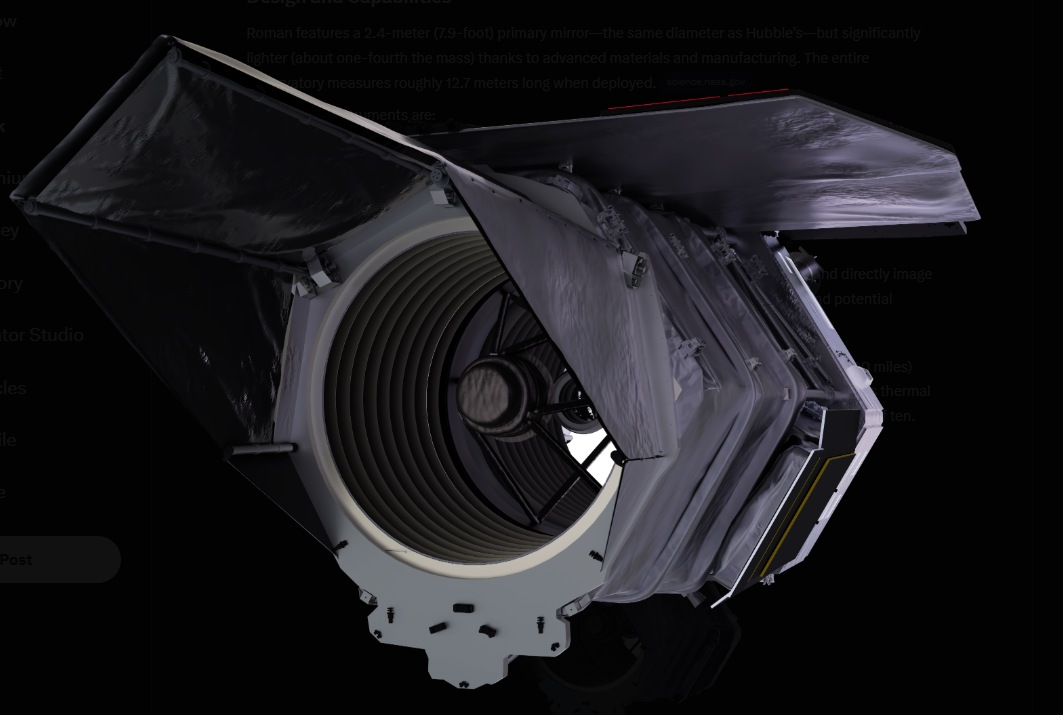
The Nancy Grace Roman Space Telescope arrives at a rare moment in astronomy: its launch window is close enough to feel real, while its scientific promise is still largely unwritten.
NASA currently lists Roman for launch on August 30, 2026 at 7:26 a.m. EDT (11:26 UTC), on a SpaceX Falcon Heavy from Launch Complex 39A at Kennedy Space Center. A launch target is not a guarantee - weather, range operations, and spacecraft readiness can move it - but the observatory is in its final launch campaign.
01A telescope for the wide view
Roman shares Hubble's 2.4-meter primary-mirror diameter, but it is designed around a very different question: what changes when sharp images cover a great deal more sky? Its Wide Field Instrument is a roughly 300-megapixel near-infrared camera with a field of view at least 100 times larger than Hubble's. One Roman pointing can therefore deliver the detail of roughly one hundred Hubble images across the same patch of sky.
That scale matters because many of astronomy's hardest questions are statistical. A single galaxy can be striking. A billion galaxies, measured consistently, can reveal subtle patterns in the universe's expansion and structure. A handful of unusual stellar brightenings can be chance; a large, well-characterized sample becomes a census of planetary systems.
Roman is a survey observatory. Its defining advantage is area plus precision: an instrument built to repeatedly map broad regions of the near-infrared sky, then leave the most interesting targets for deeper follow-up.
02Three ways to interrogate the universe
Dark energy and cosmic structure. Roman's wide imaging and spectroscopy will help measure weak gravitational lensing, galaxy clustering, and distant supernovae. These independent probes trace how structure grows and how cosmic expansion has changed. The goal is not to announce a predetermined answer about dark energy, but to test whether the data remain consistent with the simplest picture or demand something more complicated.
Planets beyond the Solar System. Roman's Galactic Bulge Time-Domain Survey will look for gravitational microlensing: brief, characteristic brightening when a foreground star and its planets pass in front of a more distant source. This technique can find worlds farther from their host stars than many transit searches reach, including low-mass planets in favorable alignments. NASA's mission material projects more than a thousand such discoveries; the final yield will depend on the sky and the survey itself.
The variable sky. Repeated observations over a vast field can find supernovae, changing stars, compact-object lensing events, and other transients that no observer could schedule in advance. The wide field is not a compromise in this program. It is the discovery engine.
03Not Webb. Not Hubble. A partner.
Roman is sometimes introduced as a successor to Hubble or a companion to the James Webb Space Telescope. Both comparisons are useful only if they are not made into a competition. Webb's larger mirror and longer infrared reach make it exceptionally suited to deep, targeted observations. Hubble remains a versatile ultraviolet, visible, and near-infrared observatory. Roman contributes context: it can map a survey field, find the rare cases, and establish the population from which a close-up target becomes scientifically meaningful.
Roman also carries a Coronagraph Instrument. It is a technology demonstration intended to advance high-contrast imaging and spectroscopy of nearby exoplanets and disks by suppressing starlight. It is important precisely because it is experimental: it is not a promise of an Earth twin, but a test of techniques that future direct-imaging missions will need.
04The name on the observatory
Nancy Grace Roman was NASA's first Chief of Astronomy and its first female executive. Before Hubble existed, she helped assemble the scientific case, technical planning, and institutional support for a large space telescope. Her work connected researchers, engineers, and decision-makers around an observatory whose value was not yet obvious to everyone who would need to support it.
Calling her the "Mother of Hubble" is not ceremonial filler. It describes the practical work of turning a scientific ambition into a mission. Roman inherits that same spirit: it is a telescope designed not only to answer familiar questions, but to make the astronomical survey a source of surprise.
05What happens next
After launch, Roman will travel toward the Sun-Earth L2 region, roughly 1.5 million kilometers from Earth, and enter a quasi-halo orbit around that gravitational balance point. There it will undergo deployment, checkout, calibration, and commissioning before routine survey work begins. This is a necessary scientific phase, not a pause before science: the instrument performance measured there will define how the observatory's future results are interpreted.
NASA plans no proprietary period for Roman data once it has been processed and delivered to the archive. That is one of the mission's most consequential design choices. The large surveys will be useful to professional teams, but they will also become a shared reference frame for anyone able to ask a good question of a public sky.
The first images will surely be beautiful. The deeper story will be quieter: carefully calibrated measurements repeated across an extraordinary expanse of the universe. Roman's promise is not just that it will see farther. It is that it will let us compare more of what we see.
PRIMARY SOURCES
Sources, dates, and image use
- NASA Science. Nancy Grace Roman Space Telescope. Mission overview, current launch target, core science goals, field-of-view framing, and mission links. Accessed August 20, 2026.
- NASA Science. NASA Fuels Roman Space Telescope for Late August Launch. Launch-preparation status and target date. July 27, 2026.
- NASA Science. Introducing the Roman Space Telescope and Why the Roman Space Telescope?. Observatory design, survey role, mirror size, instruments, and planned mission duration.
- NASA Science. Roman Observatory, Wide Field Instrument, and Coronagraph. Instrument capabilities and limitations.
- NASA Science. Who is Nancy Grace Roman?. Biographical and historical context.
- NASA Science. Roman Space Telescope Illustrations. Hero image attribution: NASA Goddard / Conceptual Image Lab.
Editorial methodology: facts and mission-status language were checked against NASA pages on August 20, 2026. Launch targets can change. NASA imagery is used with source acknowledgement under NASA's media guidance. Apeira Astra is independent and is not affiliated with, sponsored by, or endorsed by NASA.