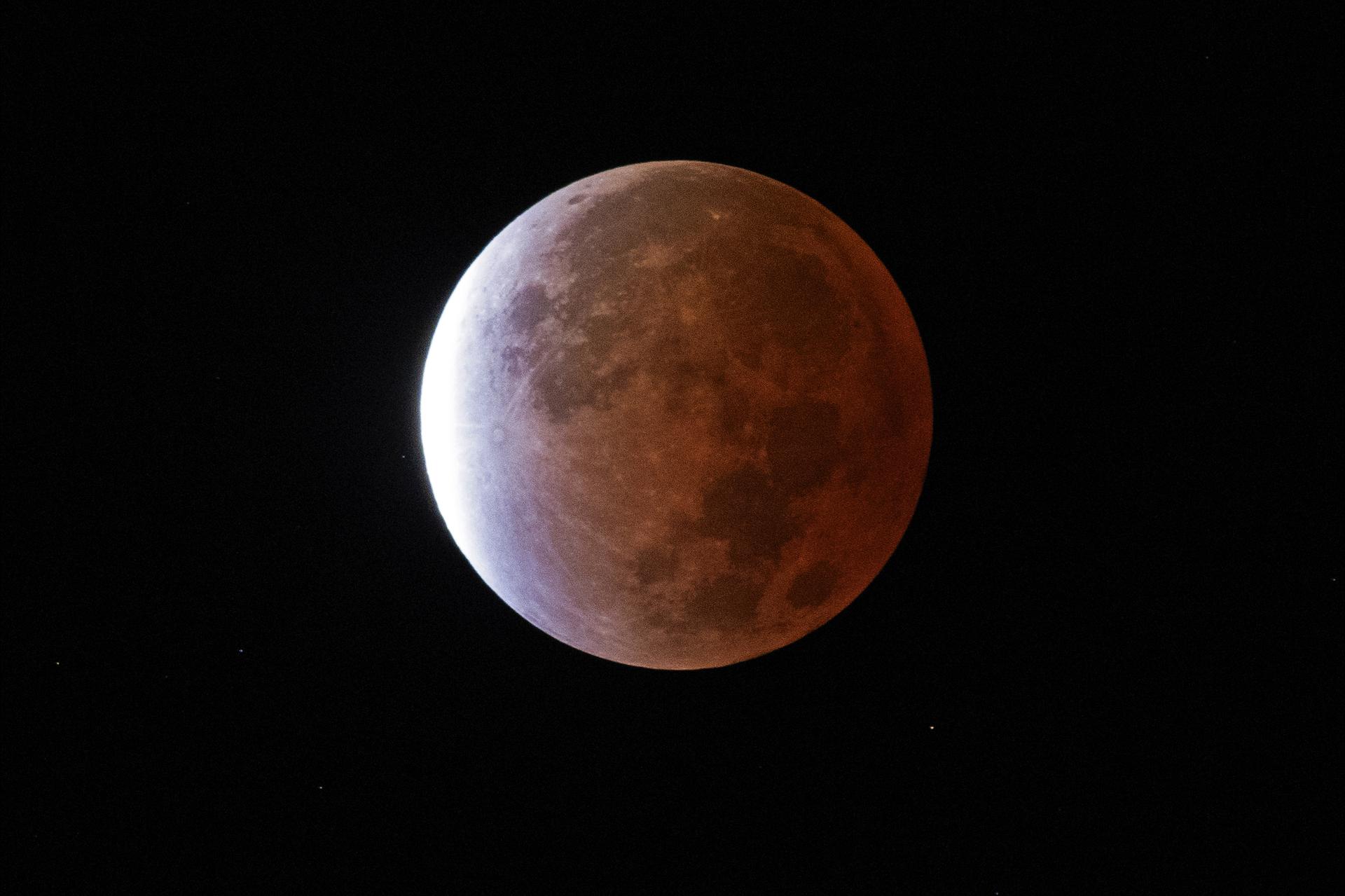
The Moon will enter Earth's faint outer shadow early this evening, then slide deeply into the umbra - the central shadow that makes a lunar eclipse unmistakable. No telescope or protective glasses are required.
01A partial eclipse only one step short of total
A lunar eclipse happens when the full Moon moves through Earth's shadow. Tonight's event is partial: part of the lunar disk enters the dark umbra, but a thin portion remains outside it even at maximum eclipse.
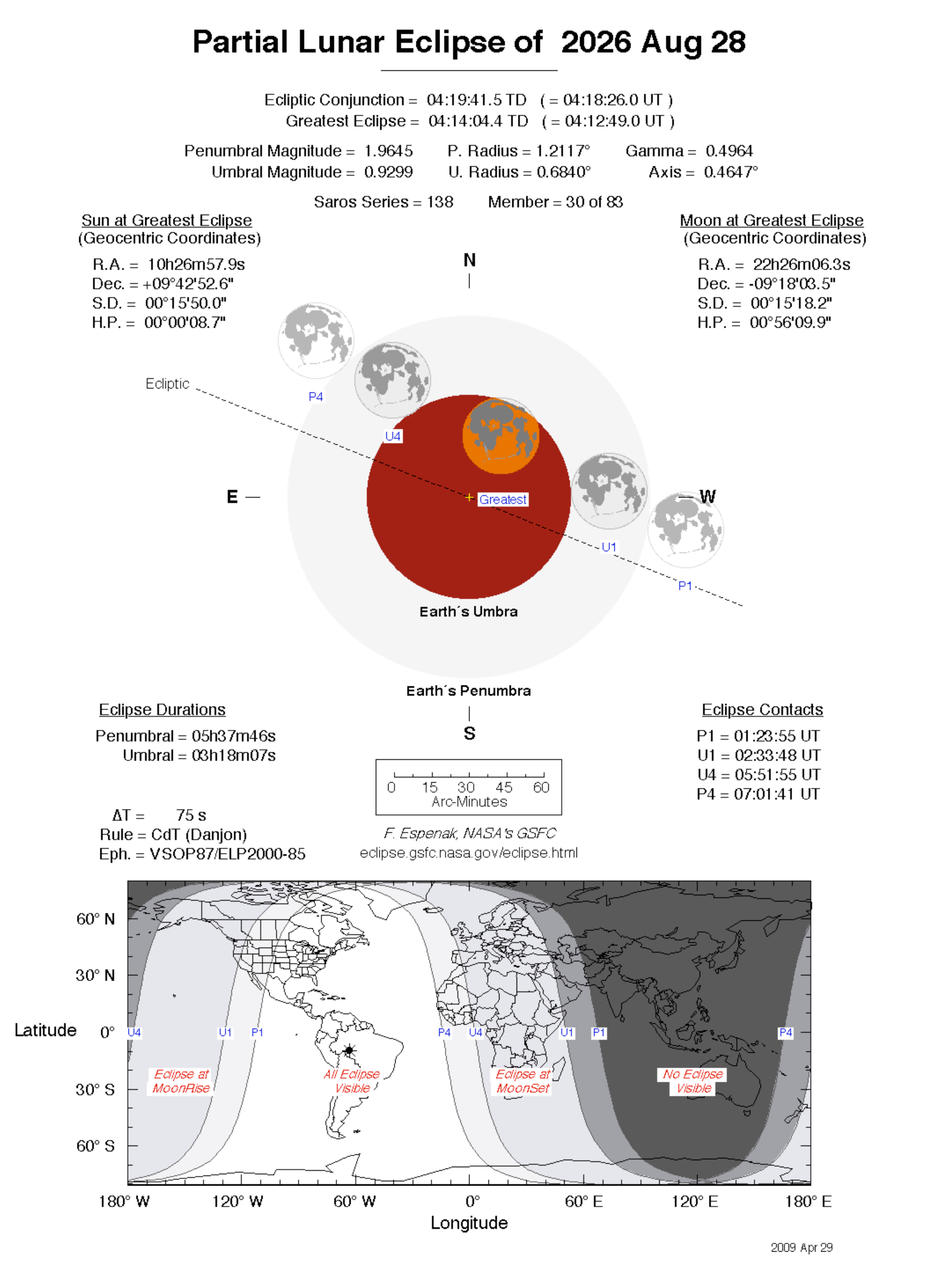
NASA's event calculation gives an umbral magnitude of 0.9299. That means the umbra reaches across 92.99% of the Moon's diameter at greatest eclipse. It does not mean exactly 92.99% of the Moon's visible area is darkened. Because the value never reaches 1.0, there is no total phase and no U2 or U3 contact.
Why it can still turn red: sunlight filtered and bent through Earth's atmosphere reaches the shadowed Moon. Blue light is scattered more strongly; the surviving red and orange light can give the eclipsed surface a copper tone. The exact color depends on clouds, dust, smoke, and aerosols around Earth's limb.
02The eclipse, stage by stage
NASA's contacts are listed below. Pacific and Eastern times use daylight time. The date changes after midnight in the Eastern time zone and at the final penumbral contact in the Pacific time zone.
| Stage | UTC | Pacific (PDT) | Eastern (EDT) |
|---|---|---|---|
| P1Penumbral eclipse begins | Aug 28 01:23:55 | Aug 27 6:23:55 p.m. | Aug 27 9:23:55 p.m. |
| U1Partial eclipse begins | Aug 28 02:33:48 | Aug 27 7:33:48 p.m. | Aug 27 10:33:48 p.m. |
| MAXGreatest eclipse | Aug 28 04:12:49 | Aug 27 9:12:49 p.m. | Aug 28 12:12:49 a.m. |
| U4Partial eclipse ends | Aug 28 05:51:55 | Aug 27 10:51:55 p.m. | Aug 28 1:51:55 a.m. |
| P4Penumbral eclipse ends | Aug 28 07:01:41 | Aug 28 12:01:41 a.m. | Aug 28 3:01:41 a.m. |
The penumbra is subtle. A dusky shading should become easier to notice as U1 approaches.
A dark, curved bite advances across the Moon for 1 hour 39 minutes.
Only a slim bright portion remains outside the umbra; most of the disk may glow copper or red.
The dark edge retreats for another 1 hour 39 minutes before the partial phase ends.
The final penumbral shading fades gradually until the full Moon returns to normal.
03Where the eclipse can be seen
The complete eclipse is visible from a broad central zone covering much of the Americas and the Atlantic. In far western North America and across parts of the eastern Pacific, the Moon rises after the eclipse has already begun. In Europe and Africa, the Moon sets during the event. Most of Asia and Australia are on Earth's daylight side or have the Moon below the horizon and will miss it.
04How to watch
Unlike a solar eclipse, a lunar eclipse is safe to watch directly. You do not need eclipse glasses. Find a location with a clear view of the Moon and allow time for clouds or local obstructions. Binoculars reveal the umbra's edge moving across craters and maria, but the event is fully visible to the unaided eye.
Observers near the Pacific coast should prioritize an unobstructed eastern horizon because the Moon rises during the opening stages. Farther east, the Moon is already higher when the penumbral phase begins. A phone or camera on a stable support can record the color change; lock exposure if possible so the bright crescent does not wash out the shadowed surface.
The first penumbral contact is not a dramatic switch. If you only have a short observing window, watch from roughly 30 minutes after U1 through 30 minutes after maximum. That interval captures the most obvious advance, the deepest eclipse, and the beginning of the retreat.
PRIMARY SOURCES
Calculations, map, and image credits
- NASA Goddard Space Flight Center. Partial Lunar Eclipse of 2026 Aug 28. Contact times, durations, umbral magnitude, geometry, and world visibility map. Calculations and graphic by Fred Espenak.
- NASA Science. Eclipses and the Moon. Lunar-eclipse geometry and the atmospheric origin of the Moon's red color.
- U.S. Naval Observatory. Lunar Eclipse Computer. Location-specific circumstance lookup.
- NASA Image and Video Library. Partial eclipse of Beaver Moon 2021. Hero photograph: NASA / Michael DeMocker.
Times are reproduced from NASA's 2026 event sheet and converted directly from UTC to PDT and EDT. The NASA hero photograph shows a prior deep partial eclipse and is labeled as illustrative. NASA material is used with source acknowledgement under NASA's media guidance; no NASA endorsement is implied.