PLANETARY SCIENCE · JULY 21, 2026 · 11 MIN READ
The asteroid shower that may have reached three worlds.
A single catastrophe in the main asteroid belt may have sent fragments toward Earth, Mars, and the Moon for roughly 150 million years. The dynamical case is compelling. Its possible consequences are even larger—and still unresolved.
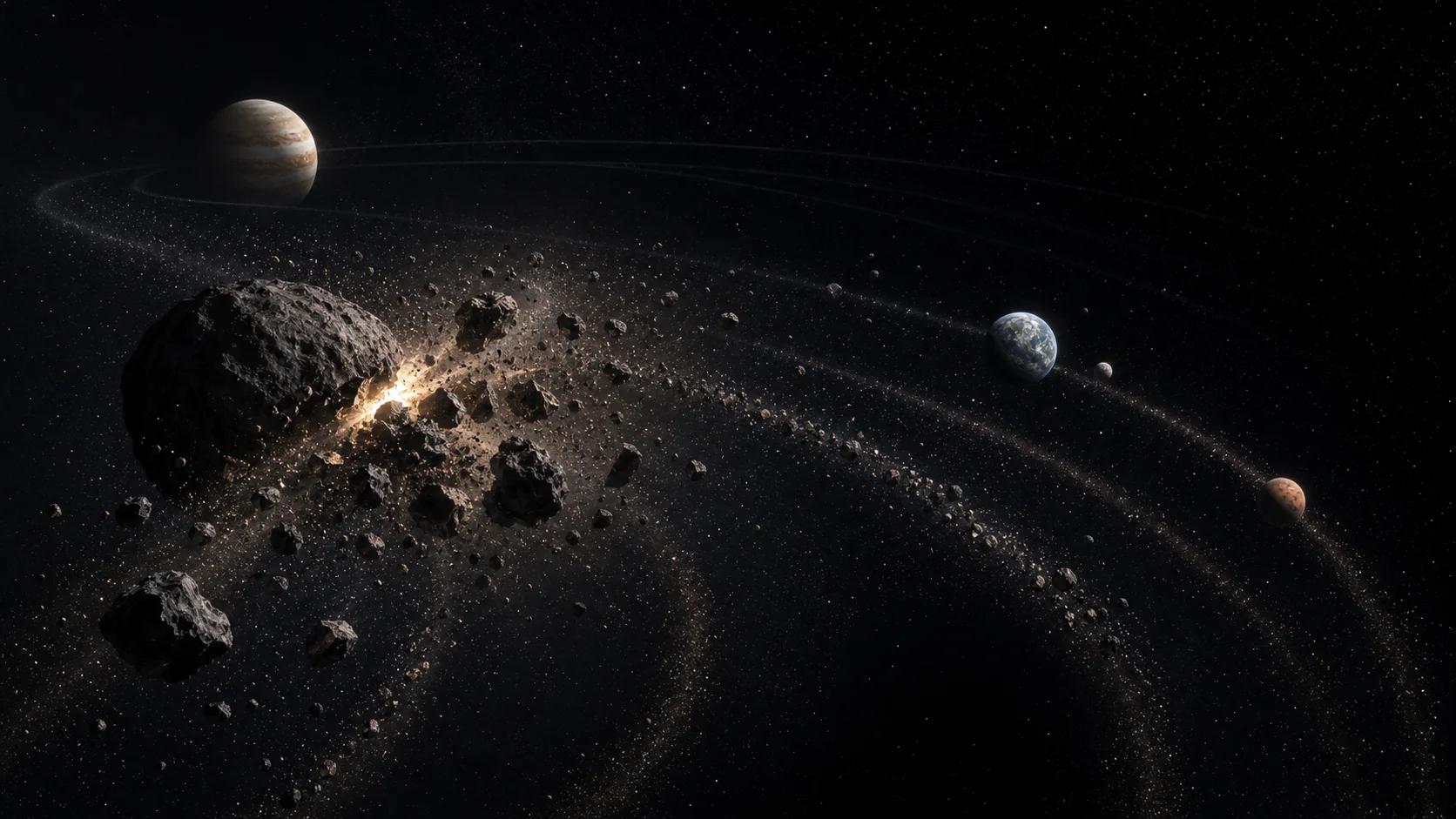
About 800 million years ago, something enormous broke in the asteroid belt. According to a new dynamical study led by Southwest Research Institute, the breakup did not remain a local event. It may have created a long-lived stream of impactors that crossed the orbits of the terrestrial planets and left a record on the one world that preserves ancient craters best: the Moon.
The proposed source is the parent body of the Eulalia asteroid family, a dark, primitive object rich in carbon-bearing material. Its original diameter was at least 100–200 kilometers and may have been larger. The study’s preferred model places its catastrophic disruption about 865 million years ago, close enough to match an otherwise puzzling concentration of lunar impact ages around 800 million years.
01 A collision in exactly the wrong place
Asteroid families are populations of fragments that share related orbits and compositions. Run their paths backward—or model how their orbits disperse—and researchers can reconstruct the destruction of a larger parent body. Eulalia is unusual not simply because of its age, but because of where the breakup occurred: near 2.5 astronomical units from the Sun, alongside one of the asteroid belt’s most efficient exits.
The simulations suggest that nearly three quarters of the family was eventually lost into Jupiter’s 3:1 mean-motion resonance over approximately 150 million years. That loss is the essential clue. A family positioned elsewhere might spread through the belt and remain there. Eulalia formed beside a gravitational conveyor capable of turning belt asteroids into planet-crossing objects.
One remote collision could become an inner-Solar-System event—not in one instant, but as a drawn-out shower.
02 Jupiter’s 3:1 resonance: an escape hatch
An asteroid in the 3:1 resonance circles the Sun three times for every orbit of Jupiter. The repeated alignment does not simply tug the asteroid back and forth. Over time, Jupiter’s gravity can amplify the object’s orbital eccentricity until its path begins crossing those of Mars and Earth. The resonance is therefore less like a stable lane and more like a chaotic doorway out of the main belt.
In the preferred Eulalia model, about half of the escaping material entered this resonance soon after the parent body broke apart. Those fragments could have reached planet-crossing space rapidly on astronomical timescales. The remainder arrived more gradually, stretching the bombardment far beyond the original collision.
03 The slow push of warm stone
The mechanism that sustained the delivery is subtle: sunlight warms an asteroid’s surface, and the rotating body later radiates that energy as heat. Photons carry momentum, so the uneven thermal emission produces a minute thrust. This is the Yarkovsky effect. For a single orbit the change is negligible; across millions of years it can shift a small asteroid’s semimajor axis enough to move it into a resonance.
The effect depends on size, spin, surface properties, and orientation. Related rotational torques, known as the YORP effect, can also alter how fragments spin and therefore how they drift. Together, these thermal processes provide a credible way for Eulalia debris to keep entering Jupiter’s 3:1 resonance for 100–150 million years after the initial burst.
04 The Moon kept the record
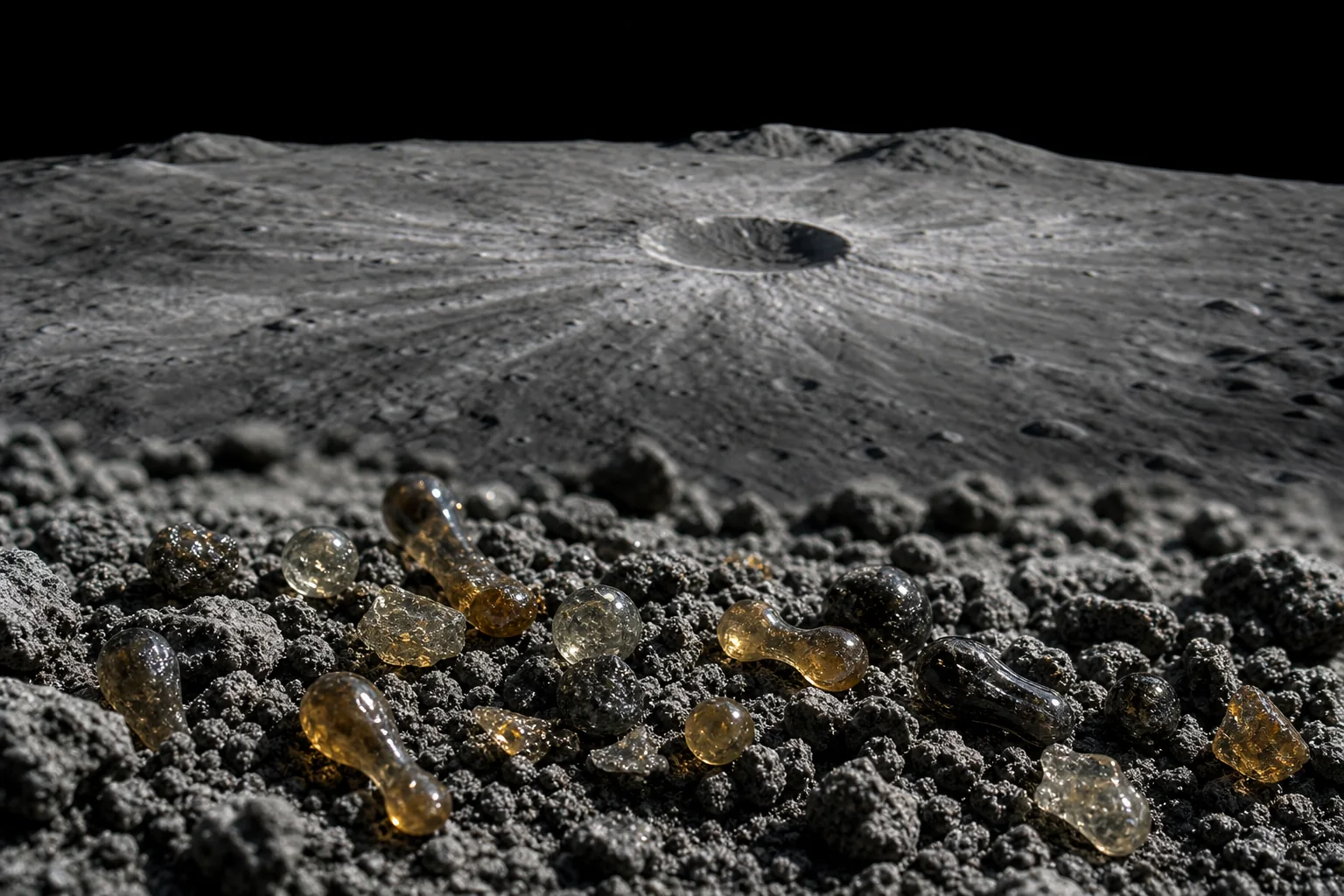
Earth’s surface is a poor archive of very old impacts. Plate tectonics recycles crust, erosion removes relief, and glaciers can scour or bury what remains. The Moon has none of those active erasers. Its cratered surface and returned Apollo samples preserve a much longer record of impacts across the inner Solar System.
Lunar impact-glass ages show a conspicuous concentration near 800 million years. Independent crater-age estimates also place several large craters in roughly the same interval, including Copernicus and six others with mean estimated ages between about 760 and 820 million years. That cluster is especially notable because the background production of large lunar craters appears to have been lower then than it is today.
The study compared the modeled Eulalia flux with this lunar chronology using Monte Carlo simulations. Much of the observed record falls within the model’s one-standard-deviation range. That is encouraging evidence for the connection, not a fingerprint that proves every crater came from Eulalia. Crater ages are uncertain, fragments can have other sources, and a dynamical model describes probabilities rather than individual impacts.
05 What Earth may have experienced
Earth presents the largest target among the three worlds. Accounting for its greater cross-sectional area and stronger gravitational focusing, a useful rule of thumb is that Earth should receive roughly 20 impacts by objects of a given size or larger for every comparable lunar impact. That multiplier is a modeled expectation—not a tally of known craters—but it turns the Moon’s spike into a sobering terrestrial scenario.
The simulations indicate an average largest Eulalia projectile of roughly eight kilometers for Earth and Venus, around 4.5 kilometers for Mars, and more than three kilometers for the Moon. Individual results vary. The important point is that the event could have supplied more than dust and pebbles: some fragments were potentially large enough to generate regional or global environmental effects.
The timing overlaps a complex chapter in Earth history. The Bitter Springs Anomaly, approximately 800–810 million years old, records a major negative shift in carbonate carbon isotopes. Far later came the Cryogenian’s severe Sturtian and Marinoan ice ages, beginning around 717 million years ago and 641 million years ago respectively. Impacts could inject dust and aerosols, disturb ocean chemistry, or affect climate. Yet the new paper does not demonstrate that Eulalia caused any of these changes, and it does not directly model the climate response.
IMPORTANT DISTINCTION
A compelling coincidence is not a causal result.
The delivery mechanism and lunar timing can be tested with dynamics and chronology. A link to Earth’s biosphere or Snowball Earth remains a hypothesis for future work. The oldest terrestrial craters are mostly gone, leaving geochemical proxies that can have several explanations.
06 Mars and a volcanic coincidence
Mars supplies a different possibility. Estimates for the ages of several large volcanic calderas show increased activity around the same broad period. Large impacts generate seismic waves that can travel around a planet; in principle, that shaking might destabilize magma reservoirs already close to eruption.
This is an intriguing mechanism, but it remains explicitly speculative. Martian surface ages carry substantial uncertainties, and temporal overlap cannot establish that impacts triggered volcanism. The value of the Eulalia model is that it supplies a physically motivated event to test against future crater dates, volcanic histories, and better geological maps.
07 What we know—and what we do not
STRONGLY SUPPORTED
A breakup beside a powerful delivery route
Eulalia is a real asteroid family next to the 3:1 resonance, and known gravitational and thermal mechanisms can move its fragments into planet-crossing orbits.
MODEL-DEPENDENT
The exact size, timing, and impact flux
The preferred solution fits important constraints, but fragment properties, crater ages, and chaotic orbital evolution create ranges rather than exact answers.
OPEN HYPOTHESES
Climate, biosphere, and volcanism
Links to Earth’s environmental transitions and Mars’s volcanic history are plausible questions raised by the timing—not conclusions established by the study.
08 Why this story matters
The most powerful idea in the study is not a single dramatic crater. It is the way a local event propagates through a connected system. A collision between asteroids can feed a Jovian resonance. Thermal radiation can steer small fragments over millions of years. Those fragments can then encounter several planets, each preserving—or erasing— a different part of the evidence.
That chain turns the Moon into an archive for Earth, an asteroid family into a record of vanished projectiles, and celestial mechanics into a tool for investigating ancient geology. The Eulalia hypothesis will become stronger or weaker as lunar samples are dated more precisely, crater chronologies improve, and researchers search terrestrial and Martian rocks for a shared chemical signature. For now, it is a rigorous model with an extraordinary implication: one distant smash-up may have written a chapter across three worlds.
PRIMARY & FURTHER READING
Sources
- Bottke, W. F., Vokrouhlický, D., Dykhuis, M., & Zellner, N. “An 800-Million-Year-Old Impact Shower on the Terrestrial Planets from the Breakup of the Eulalia Parent Body.” The Planetary Science Journal. DOI: 10.3847/PSJ/ae74cc.
- Open-access manuscript and abstract on arXiv.
- Southwest Research Institute press release via EurekAlert!, July 15, 2026.
- SciTechDaily overview, July 21, 2026.
- Additional coverage from The Brighter Side.
Apeira Astra used the accepted scientific manuscript as the authority for quantitative claims and uncertainty. Secondary coverage was used for context. Original illustrations are conceptual and were reviewed against the paper’s proposed physical sequence.