Astronomers found a true sugar between the stars.
Erythrulose, a four-carbon molecule detected in a cold cloud near the Milky Way’s center, pushes interstellar chemistry into new territory. The radio evidence is strong. What it means for the origin of life is more intriguing—and much less settled.
ASTROCHEMISTRY · JULY 2026 · 12 MIN READ
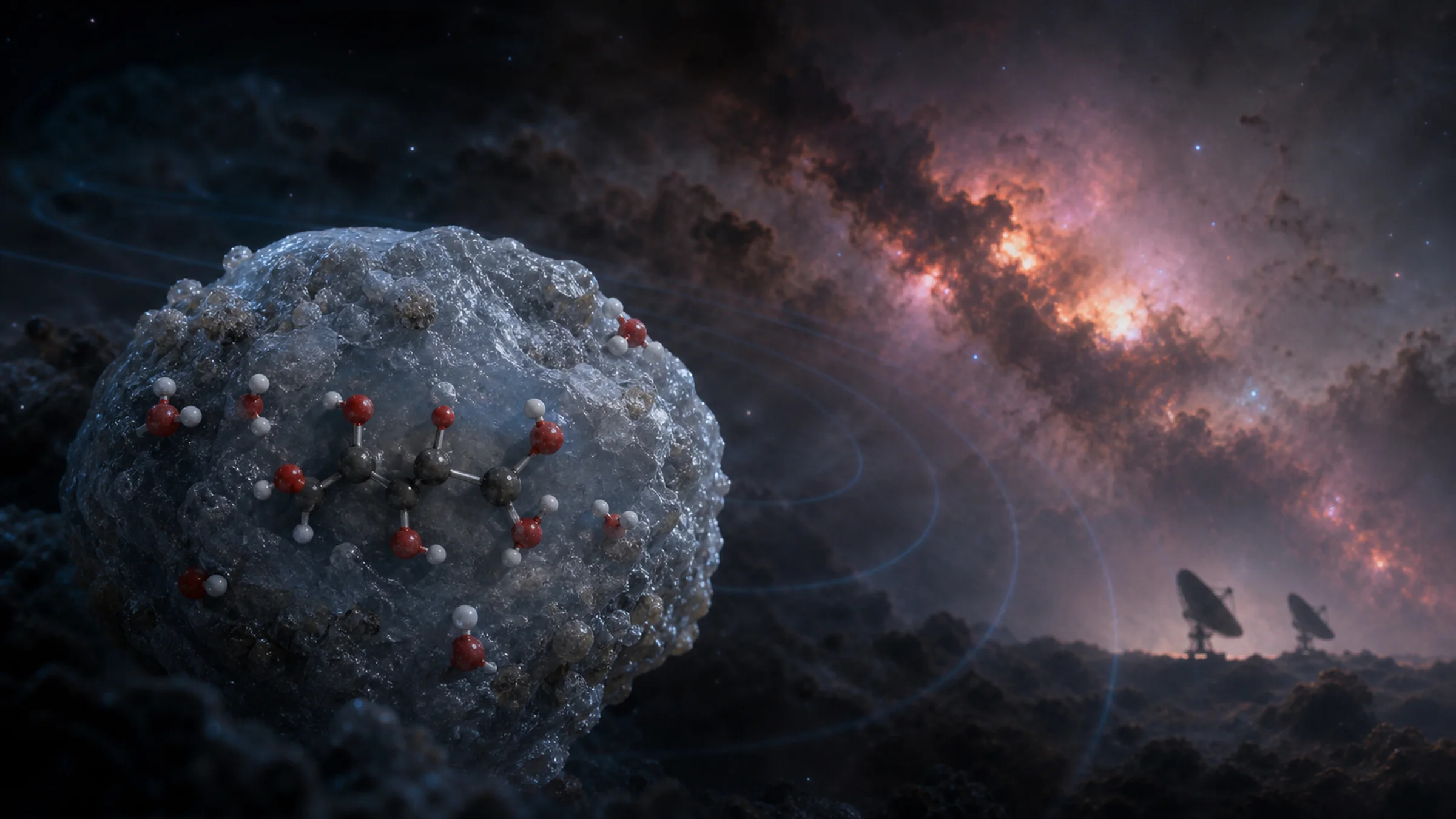
Original conceptual illustration. The foreground grain and molecular model are enlarged across many orders of magnitude; the scene is not to scale and does not represent a direct photograph of erythrulose.
Study at a glance
- ~26,700 light-years — distance to the Galactic-center region containing G+0.693
- 17 transitions — individual rotational transitions assigned to erythrulose
- 6 predominantly unblended sets — the cleanest spectral evidence
- 0.2% — estimated probability that all six clean features aligned by chance
- 11.3 ± 1.8 K — fitted excitation temperature
- ≥8–17× — erythrulose’s abundance relative to the undetected three-carbon sugars
In this story
- A molecular cloud with unusually rich chemistry
- How a radio telescope identifies a molecule
- Why “first sugar” needs an asterisk
- The missing three-carbon sugars
- A possible factory on icy grains
- What this does—and does not—say about life
- What we know, what is modeled, what remains open
- The next molecules to look for
There was no flash in a telescope image and no glittering crystal suspended against the Milky Way. The discovery arrived instead as a pattern: a set of faint radio lines emerging from an enormous cloud of gas and dust near the center of the Galaxy.
Those lines match erythrulose, a four-carbon ketose with the formula C₄H₈O₄. On Earth it occurs in nature and is also used in some sunless-tanning products. In space, its significance has nothing to do with sweetness. Erythrulose is a genuine monosaccharide—a member of the chemical family that includes the sugars biology uses for energy, structure and genetic material.
An international team led by Izaskun Jiménez-Serra of Spain’s Center for Astrobiology reports the detection in Nature Astronomy. The result is built on an ultrasensitive survey with the Yebes 40-meter and IRAM 30-meter radio telescopes, laboratory rotational spectroscopy, and a detailed model of the chemically crowded source. The authors identify 12 sets of spectral lines representing 17 individual transitions. Six sets are predominantly unblended, and the paper estimates only a 0.2% probability that those six features would coincide by chance. [1]
That makes the detection itself a persuasive result. The larger story—whether sugars made between stars became feedstock for chemistry on the young Earth—requires a longer chain of inference.
01 A cold cloud with a crowded spectrum
The source, G+0.693−0.027, lies in the Sagittarius B2 complex within the Milky Way’s Central Molecular Zone, about 8.2 kiloparsecs from Earth. It is not a tranquil version of a nearby dark cloud. Gas in the Galactic center is exposed to strong radiation fields, enhanced cosmic-ray ionization and turbulence. G+0.693 also appears to be affected by a cloud–cloud collision, producing shocks that can knock molecules off icy dust grains and into the gas, where radio telescopes can detect them. [2]
The cloud is nevertheless cold where its complex molecules radiate: many are subthermally excited, and the fitted excitation temperature for erythrulose is 11.3 ± 1.8 kelvin. That low excitation helps. Hotter sources can produce forests of overlapping lines so dense that assigning a weak feature becomes difficult. G+0.693 is chemically rich—more than 180 molecular species and isotopologues were included in the team’s spectral model—but it has not yet reached the same confusion limit.
The observations cover more than 91 gigahertz of bandwidth across the 7-, 3- and 2-millimeter atmospheric windows. Yebes supplied continuous coverage from 31.07 to 50.42 GHz, while IRAM extended the search through several bands from 83.2 to 173.81 GHz. The strongest erythrulose features occur in the Yebes range, but the broader survey gives the researchers a crucial check: favorable transitions should appear where the molecular model predicts them, and strong predicted lines should not simply be absent. [3]
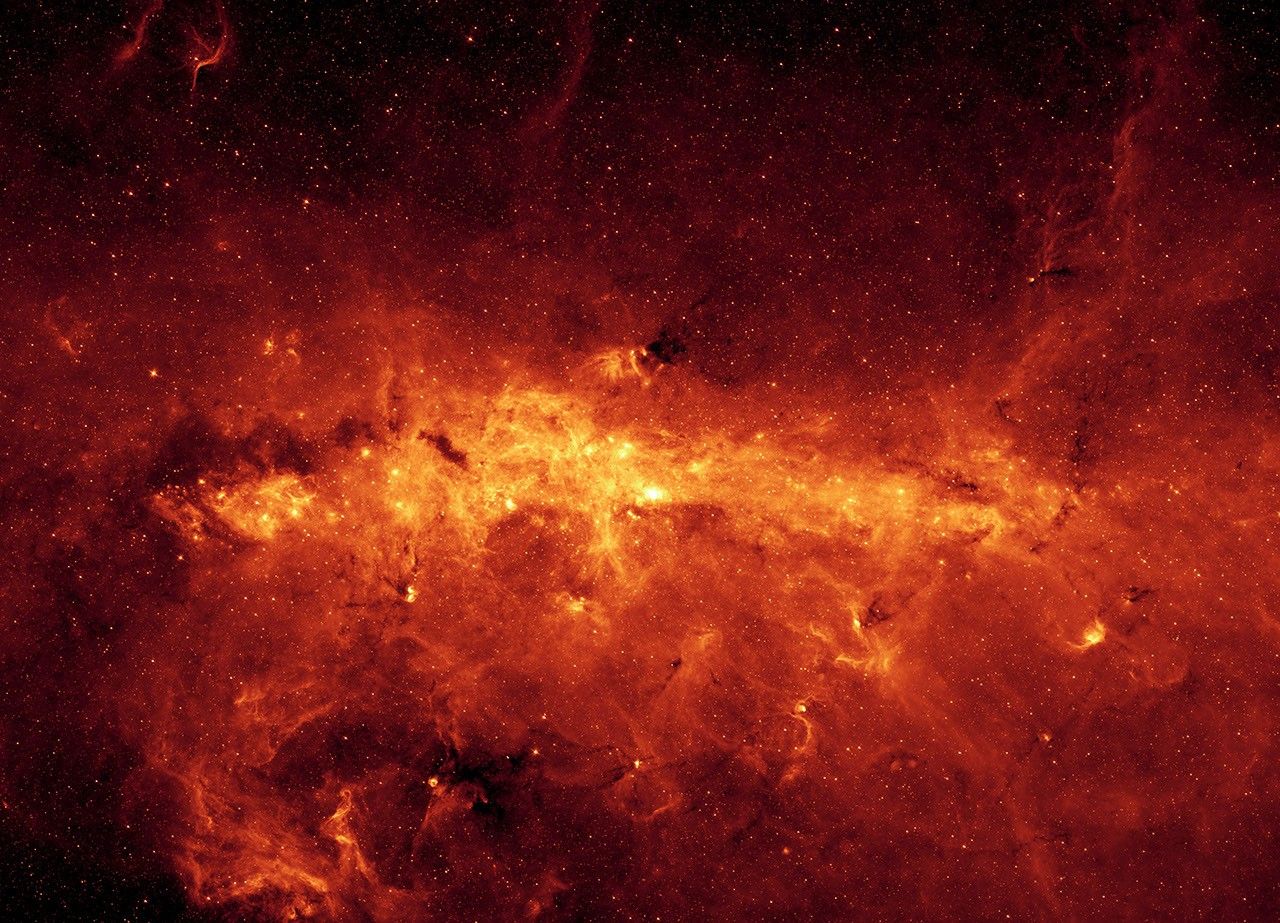
The Milky Way’s dusty center in infrared light, observed by NASA’s Spitzer Space Telescope. This wide-field image provides regional context; G+0.693 is not individually marked. Credit: NASA/JPL-Caltech, PIA03653. [4]
02 Molecules as radio fingerprints
A radio telescope does not scoop erythrulose out of the cloud. It records radiation at particular frequencies. A molecule can rotate only in allowed quantum states, and transitions between those states emit or absorb photons at a distinctive set of frequencies. The complete pattern functions like a fingerprint—but only if its laboratory spectrum is known accurately enough.
Sugars have been unusually difficult targets. They are thermally fragile and strongly attract water, complicating efforts to vaporize them without decomposition. Recent ultrafast laser-vaporization experiments made precise gas-phase rotational measurements possible for erythrulose and several other sugars. Those laboratory frequencies gave astronomers the catalogue they needed to search the sky. [1]
The team then compared the predicted erythrulose spectrum with the G+0.693 survey using the MADCUBA-SLIM analysis package. The 12 fitted line sets all have integrated intensities of at least nine times the relevant noise estimate. Six have no more than 25% contamination from other modeled emission. Other sets overlap known species or still-unidentified lines, but their shapes and intensities agree with the global model. Weaker transitions not used in the fit are also broadly consistent with the data.
This is the important distinction between a single suggestive bump and a molecular detection. Confidence comes from a family of lines arriving at the right frequencies, with the right widths, velocities and relative intensities, while the rest of the predicted spectrum remains compatible with what was observed.
The discovery is not an image of sugar in space. It is a many-line spectroscopic identification whose strongest case comes from consistency across the whole frequency pattern.
The fitted column density is (8.7 ± 0.8) × 10¹³ molecules per square centimeter along the line of sight. Relative to molecular hydrogen, the inferred abundance is (6.4 ± 0.6) × 10⁻¹⁰. That is sparse by terrestrial standards, but entirely measurable across the immense column of material in a Galactic-center cloud.
03 The “first sugar” discovered twice
In 2000, a paper by Jan Hollis, Frank Lovas and Philip Jewell announced interstellar glycolaldehyde with an unforgettable title: “Interstellar Glycolaldehyde: The First Sugar.” The molecule was detected toward Sagittarius B2(N), and the description became standard in astronomy coverage. [5]
The new paper calls erythrulose the first interstellar sugar without denying that history. The apparent contradiction is a question of definition.
Glycolaldehyde, HOCH₂CHO, has two carbon atoms, one aldehyde group and one hydroxyl group. It is often called the simplest sugar-like molecule or an aldodiose, and it is chemically important as a precursor to larger carbohydrates. Under the stricter biochemical definition, however, a monosaccharide is a polyhydroxy aldehyde or ketone and normally contains at least three carbon atoms. Glycolaldehyde is a hydroxyaldehyde, not a polyhydroxy saccharide.
Erythrulose clears that bar. Its open-chain structure contains four carbons, a ketone group and multiple hydroxyl groups. It is the sole four-carbon ketose. This is why careful accounts describe the 2026 result as the first true sugar detected in the interstellar medium: not the first molecule ever nicknamed a sugar, but the first unambiguous monosaccharide under the stricter chemical definition. Chemists interviewed by Chemical & Engineering News emphasized the same distinction. [6]
Both discoveries retain their importance. Glycolaldehyde opened the observational path and remains a plausible building block. Erythrulose crosses a structural threshold.
04 The missing rung in the carbon ladder
One of the result’s strangest features is not what appeared, but what did not.
The survey also searched for the two three-carbon sugars glyceraldehyde and dihydroxyacetone. Neither was detected. Their abundance limits are ≤4 × 10⁻¹¹ and ≤7 × 10⁻¹¹ relative to hydrogen, respectively. Erythrulose appears at least 8 to 17 times more abundant, even though increasing molecular size usually makes members of an interstellar chemical family progressively rarer.
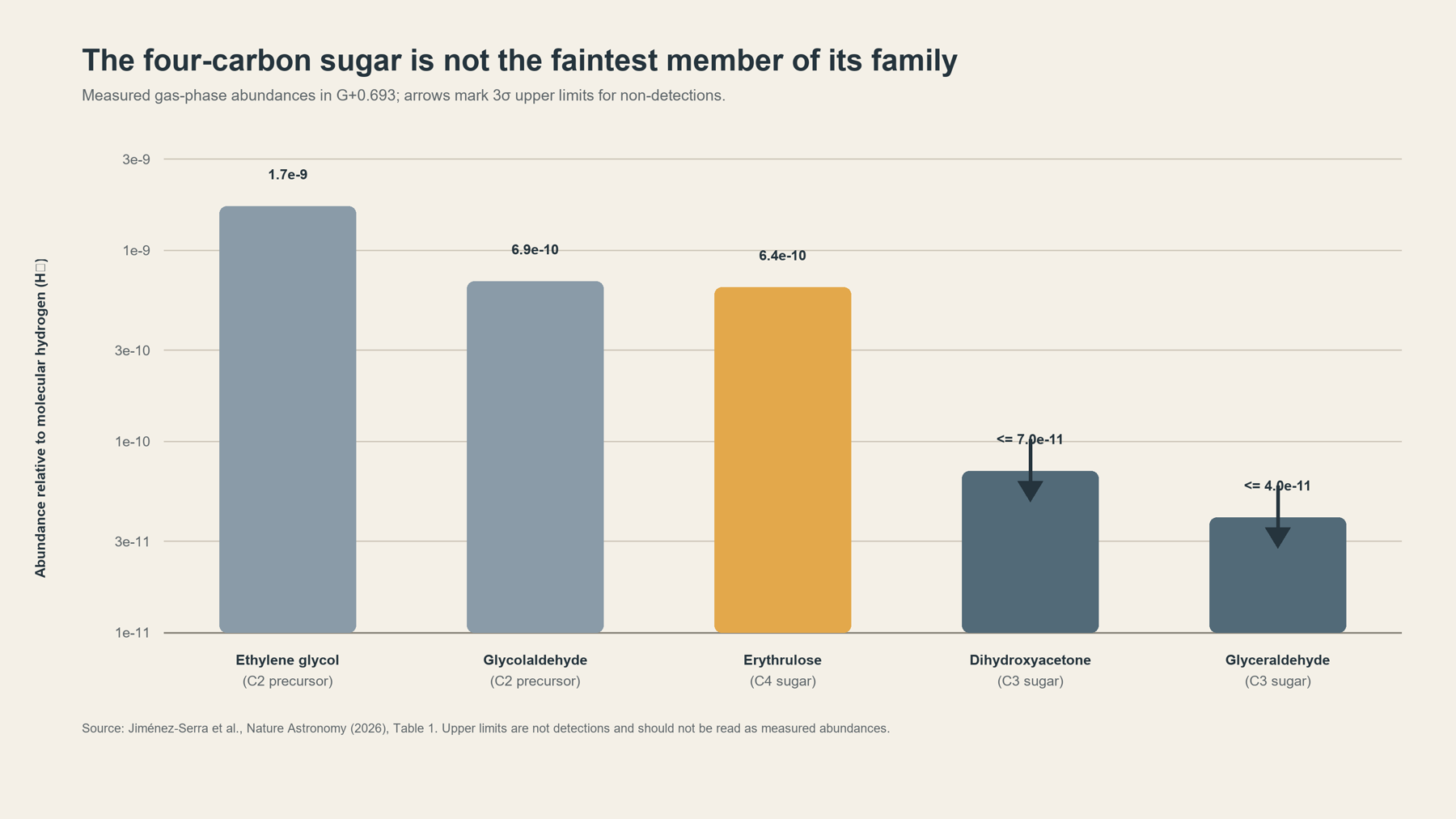
Erythrulose is measured at an abundance similar to glycolaldehyde, while the two three-carbon sugars remain below the survey’s detection limits. Chart created from Table 1 of Jiménez-Serra et al.; arrows are upper limits, not measurements. [1]
The result is unlikely to mean that interstellar chemistry simply “skipped” three carbons everywhere. Detectability depends on how efficiently a molecule forms, how easily radiation or ions destroy it, whether it remains frozen to dust, how readily shocks release it, and whether its rotational lines fall in a useful observing band. The authors’ chemical simulations, for example, assume that larger sugars can distribute absorbed energy across more internal motions and may therefore photodissociate more slowly than the three-carbon species.
That assumption helps reproduce the observed ordering, but the model overproduces the C3 sugars in ice by factors of roughly 25–70. The discrepancy is not hidden in the paper. It points to missing or uncertain chemistry: different desorption efficiencies, rapid re-freezing, gas-phase destruction, uncertain branching ratios or photodissociation rates.
The abundance comparison is therefore a clue, not a closed case. It says that a larger interstellar molecule need not be rarer than every smaller analogue—and that carbon count alone is a poor guide to what a telescope will find.
05 A factory on grains of ice
The proposed formation route begins with two abundant two-carbon molecules: glycolaldehyde and ethylene glycol. Both are already present in G+0.693, at about 1.1 and 2.7 times the abundance of erythrulose.
On an amorphous water-ice surface, incoming hydrogen atoms can remove hydrogen from those molecules, creating reactive radical fragments. The team’s quantum-chemical calculations find a sequence in which the activated fragments eventually recombine through a spin-changing step to form erythrulose. Quantum tunneling can make hydrogen-abstraction reactions proceed even at the 20–30 K dust temperatures expected in Galactic-center clouds.
The researchers inserted this pathway into a kinetic Monte Carlo model of ice-mantle growth. Across a range of cosmic-ray ionization rates, the simulations produce both three- and four-carbon sugars, with erythrulose generally the most abundant C4 sugar. Low-velocity shocks in G+0.693 could then sputter part of that icy material into the gas.
This is a physically motivated pathway, not a directly observed reaction movie. The rate calculations depend on a modeled ice geometry and electronic-structure methods. The cloud simulation omits an extended gas-phase network for the complex organics, and several reaction rates remain uncertain. Even in the favored high-ionization models, predicted and observed abundance ratios can differ by more than an order of magnitude.
MODEL-DEPENDENT
The calculations show that erythrulose can plausibly form on cold interstellar ice and reach the observed order of abundance. They do not establish that this is the only pathway, or that every step has been measured in a laboratory ice experiment.
The model’s real value is sharper than a claim of proof: it links the detected molecule to testable precursor abundances, grain chemistry and environmental conditions. Future laboratory work can challenge individual rates. Searches in clouds with different radiation and shock histories can test whether erythrulose tracks the proposed ingredients.
06 A new ingredient is not a recipe for life
Sugars occupy a privileged place in biology. Ribose forms the backbone of RNA; deoxyribose does the same for DNA; other sugars store energy and build cellular structures. Prebiotic chemists have long faced a concentration problem: plausible early-Earth reactions often produce messy mixtures or insufficient amounts of the particular sugars needed for later chemistry.
Meteorites contain ribose and other sugars, and NASA’s returned samples from asteroid Bennu added evidence that biologically relevant carbohydrates can form in extraterrestrial material. The erythrulose detection moves the possible starting point earlier—from an asteroid parent body back into the material between stars. [7]
Erythrulose itself is not ribose, and the observation does not show a path from a molecular cloud to a living system. But ketoses can isomerize into corresponding aldoses in water. Erythrulose can produce threose and erythrose, molecules relevant to experimental routes toward alternative nucleic-acid backbones. The paper also notes that prebiotic nucleotide syntheses have used mixtures containing erythrulose as an input.
The authors go further and estimate that roughly 0.5–50 billion kilograms of erythrulose could have reached early Earth, based on its ratio to water in G+0.693, average meteoritic water content and estimates of total organic delivery. That range is best understood as an order-of-magnitude scenario. It assumes that a remote Galactic-center cloud is a useful analogue for material inherited by the solar system, that abundance ratios survive multiple stages of processing, and that debated impact-flux histories are approximately applicable.
Independent experts have welcomed the detection while drawing a bright line around its meaning. Astrobiologist César Menor Salván cautioned that the work does not solve the origin of life or the origin of DNA and RNA. Andrés de la Escosura Navazo noted that five- and six-carbon sugars would be more directly significant biochemically, although the present result makes their detection seem less remote. [8]
IMPORTANT DISTINCTION
Finding a prebiotic ingredient is not finding prebiotic evolution.
The detection demonstrates that abiotic interstellar chemistry can build and preserve a genuine four-carbon sugar. It does not show that the molecule reached Earth, accumulated in a useful environment, survived competing reactions or participated in the emergence of replication.
Those are separate questions—and each needs separate evidence.
07 What we know—and what we do not
STRONGLY SUPPORTED
Erythrulose is present in the gas toward
G+0.693.
Multiple transitions match laboratory frequencies, line velocities and
relative intensities. Six predominantly unblended sets provide the
cleanest support, and the broader predicted spectrum is consistent with
the survey.
The molecule crosses a meaningful complexity
threshold.
Erythrulose has 14 atoms, four oxygens and one chiral center. The
authors describe it as the largest non-cyclic molecule and the first
four-oxygen molecule yet identified in the interstellar medium, as well
as only the second chiral interstellar molecule reported.
The result changes the search space.
Accurate laboratory spectra and sensitive broadband surveys can now
reach fragile, oxygen-rich species previously considered impractical
targets.
MODEL-DEPENDENT
The dominant formation pathway.
The glycolaldehyde-plus-ethylene-glycol mechanism is chemically
plausible and performs reasonably in simulations, but reaction networks,
ice structures and destruction rates remain incomplete.
The true abundance hierarchy.
The C3 sugars are non-detections with upper limits. Their lower apparent
abundance could reflect formation, destruction, release from grains or
observational selection.
Delivery to young planets.
Interstellar organics can be inherited by disks and incorporated into
small bodies, but the survival and concentration of erythrulose through
that chain have not been measured.
OPEN HYPOTHESES
A role in the origin of nucleic acids.
Erythrulose can participate in relevant laboratory chemistry, yet no
continuous natural pathway from interstellar synthesis to RNA or TNA has
been demonstrated.
A universal Galactic sugar inventory.
One extraordinary cloud is not a census. G+0.693’s shocks, radiation and
chemistry may be unusual.
A preference for molecular handedness.
Erythrulose is chiral, but the modeled grain-surface pathway produces
its two mirror forms equally. The radio observations do not measure an
enantiomeric excess.
08 The next rung on the ladder
The immediate targets are obvious: verify erythrulose in other clouds, push the limits on glyceraldehyde and dihydroxyacetone, and search for the C4 aldoses threose and erythrose. Each result would discriminate among formation and destruction pathways.
Longer term, the prize is not simply a larger molecule. Ribose and glucose would connect much more directly to known biochemistry, but they are spectroscopically and chemically demanding. Their many conformations spread signal among numerous weak transitions. Detecting them will require exceptionally accurate laboratory catalogues, quieter astronomical sources, broad frequency coverage and perhaps new facilities.
There is also a deeper observational question. The inventory measured in a Galactic-center shock is gas released from grains under one set of conditions. What reaches a protoplanetary disk, survives inside an asteroid and arrives on a wet planet may be a highly filtered subset. Linking those stages will require comparative chemistry across molecular clouds, disks, comets, meteorites and returned samples.
The erythrulose result matters because it places a new, firm marker at the beginning of that chain. Four-carbon sugar chemistry is not confined to planets, oceans or laboratory flasks. It can emerge in the raw material from which planetary systems are assembled.
That conclusion is substantial enough without turning it into a discovery of life. The space between stars has shown that it can make one more class of biologically useful molecule. What worlds do with that inventory remains the larger mystery.
Sources
- Jiménez-Serra, I., García de la Concepción, J., Cuppen, H. M. et al. “Detection of a four-carbon sugar in interstellar space.” Nature Astronomy (2026). DOI: 10.1038/s41550-026-02905-7. Open manuscript and full methods: arXiv HTML.
- Zeng, S. et al. “Cloud–cloud collision as drivers of the chemical complexity in Galactic Centre molecular clouds.” Monthly Notices of the Royal Astronomical Society 497 (2020): 4896–4909.
- Jiménez-Serra et al., “Observational campaign and spectral coverage” in the open manuscript.
- NASA/JPL-Caltech. “The Milky Way Center Aglow with Dust.” PIA03653.
- Hollis, J. M., Lovas, F. J. & Jewell, P. R. “Interstellar Glycolaldehyde: The First Sugar.” The Astrophysical Journal Letters 540 (2000): L107–L110.
- Georgescu, A. “Astronomers detect sugar in interstellar space for the first time.” Chemical & Engineering News, July 13, 2026.
- Furukawa, Y. et al. “Bio-essential sugars in samples from asteroid Bennu.” Nature Geoscience 19 (2026): 19–24; published online December 2, 2025.
- Science Media Centre Spain. “Sugar has been detected in interstellar space,” expert reactions, July 2026.
- Nature Portfolio. “Astronomy: Sugar detected in interstellar space,” press release, July 13, 2026.
- Ramakrishnan, A. “In a sweet discovery, astronomers find sugar lurking in the space between stars.” Associated Press, July 2026.
Editorial methodology: quantitative claims and limitations were checked against the peer-reviewed paper and open manuscript. Independent expert commentary was used to calibrate the origins-of-life framing. The hero artwork is an original conceptual illustration; the abundance chart was recreated from the paper’s reported values and clearly distinguishes upper limits from detections.